

Appearance
Update Your Brand Voice
Your voice evolves as your brand grows.
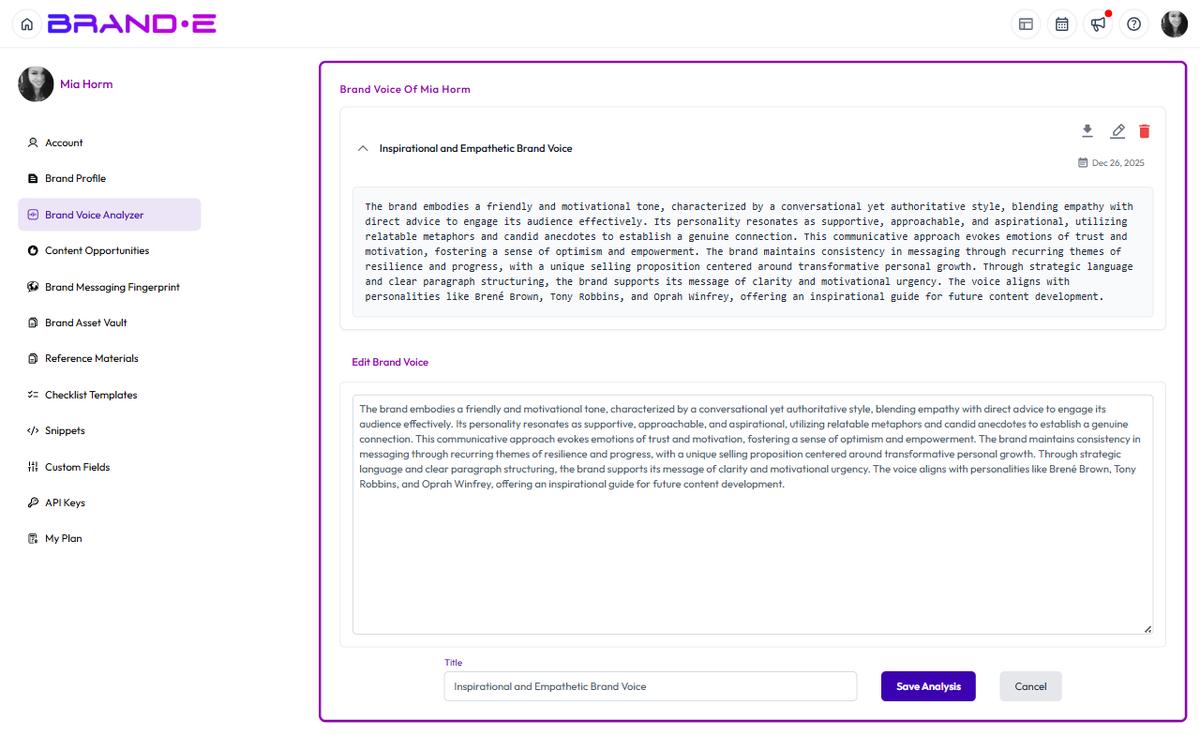
Quarterly updates keep your Brand DNA fresh and your content generation accurate.
Stale voice profiles create stale output.
When to Update Your Brand Voice
After you publish new, best-performing content
If you've published content in the last month that performed better than usual:
- A LinkedIn post with high engagement
- An email with strong open rates
- A blog post with high traffic
Add these examples to your voice profile.
They signal a shift in your communication style.
When your messaging or positioning changes
If you've repositioned your brand:
- New target audience
- New value proposition
- New business model
Add new content examples that reflect the new positioning.
Then re-analyze.
Your voice profile should match your current positioning, not your old one.
Quarterly wellness check
Every 90 days, review your voice profile.
Is it accurate?
Are you publishing content that matches this profile?
Is the profile still guiding good output?
If anything feels off, refresh it.
When output doesn't match your voice
If Brande.ai generates content that feels off-brand:
- Wrong tone (too formal when you're casual)
- Wrong audience address (generic when you're specific)
- Wrong emotional tone (serious when you're playful)
Your voice profile may be outdated or incomplete.
Re-analyze with current content examples.
How to Update Your Brand Voice
1. Navigate to Brand Voice
Go to Account → Brand Voice Analyzer.
You'll see your existing voice profile and any previous analyses.
2. Add New Content Examples
Click Add Content or +.
Choose a type: Text, File, Media File, or URL.
Add 1–2 new examples of your recent best-performing content.
3. Label the New Content
Add a note to yourself:
Good labels:
- "Recent LinkedIn posts performing well"
- "New positioning - focus on speed, not features"
- "Founder video from March 2024"
- "Updated homepage copy"
This helps you remember what changed.
4. Click Analyze
Brande.ai processes the new content and generates an updated analysis.
5. Review the Updated Analysis
Compare the new analysis to the old one.
What changed?
What stayed the same?
Look for:
- New emotional tone or storytelling patterns
- Shift in audience address or language style
- New signature words or phrases
- Changes in formality or pacing
6. Edit if Needed
If the analysis misses something, click Edit and add detail.
Example addition:
"Previous profile: 'You use casual language.' Updated note: We've shifted to more professional language in recent months. Tone is still conversational but less jokey. Balance is now 70% professional, 30% casual."
7. Save the Updated Profile
Click Save Analysis.
The updated profile takes effect immediately.
All future content generation references this new profile.
What Changes in a Voice Update
Adding specificity
Old profile:
"Your tone is conversational and friendly."
Updated profile:
"Your tone is conversational, direct, and audience-focused. You acknowledge the reader's pain first, then present your solution. You use short sentences and avoid jargon. You're friendly without being jokey."
Capturing new patterns
Old profile:
(No mention of emojis or formatting)
Updated profile:
"You use one emoji per LinkedIn post, strategically placed for emphasis, not decoration. You format lists with dashes, not numbers. You use line breaks for pacing."
Evolving emotional tone
Old profile:
"Your emotional tone is confident and authoritative."
Updated profile:
"Your emotional tone has evolved. You project confidence but also accessibility. You've moved away from authority and toward partnership. You want your audience to feel 'we can do this together,' not 'follow the expert.'"
Reflecting audience shifts
Old profile:
"You address seasoned marketers."
Updated profile:
"You now address two audiences equally: (1) CMOs managing large teams, and (2) solo founders doing marketing themselves. Your messaging acknowledges both, avoiding jargon for the solo founders while addressing strategic complexity for the CMOs."
Best Practices for Voice Updates
Don't update on one piece of content
Wait until you have 2–3 pieces of new content that show a pattern.
A single viral post doesn't mean your voice changed.
Update with diverse examples
Don't update with only LinkedIn posts.
If you've launched a newsletter, update with a newsletter excerpt.
If you've recorded videos, update with a video.
Diversity prevents over-correction.
Keep old analyses for reference
If you ever want to see how your voice has evolved, you can review old analyses.
Some platforms let you view version history.
Use it.
Edit the analysis, not just add examples
Simply adding new examples and re-analyzing isn't always enough.
If Brande.ai's description is missing nuance, edit it directly.
Add context, clarify contradictions, call out new patterns.
The more detailed your voice profile, the better your output.
Test output after updating
After updating your voice profile, create a test project.
Does the generated content feel more on-brand?
Or does it still feel off?
If still off, the profile may need more work.
Example: Voice Update Workflow
Initial Setup (Month 1)
Voice profile created during onboarding with:
- 3 LinkedIn posts
- Homepage copy
Analyzer summary:
"Professional but accessible. You speak to busy marketing leaders. Short sentences. Focus on time and simplicity."
Month 3: First Update
Performance data shows:
- Emotional, personal posts outperform formal ones
- Audience includes more founders than C-suite
Actions:
- Add 2 new LinkedIn posts with higher personal vulnerability
- Add founder interview video
- Re-analyze
Updated profile:
"Professional but human. You speak to marketing leaders and founders equally. You share challenges before solutions. Short sentences. Focus on simplicity and speed. You're confident but not arrogant—you acknowledge that marketing is hard."
Month 6: Second Update
New brand positioning launched.
Actions:
- Add new website copy with updated messaging
- Add customer testimonial reflecting new positioning
- Re-analyze
Updated profile:
"You've shifted from 'tools for marketing teams' to 'brand-aware content system.' Professional but human tone stays. New emphasis: you're solving for consistency and governance, not just speed. You now mention 'Brand DNA' as a core concept. Emotional tone is partnership-focused."