

Appearance
Update Your Brand Messaging Fingerprint
Your Brand Messaging Fingerprint is how your brand tells its story to the world.
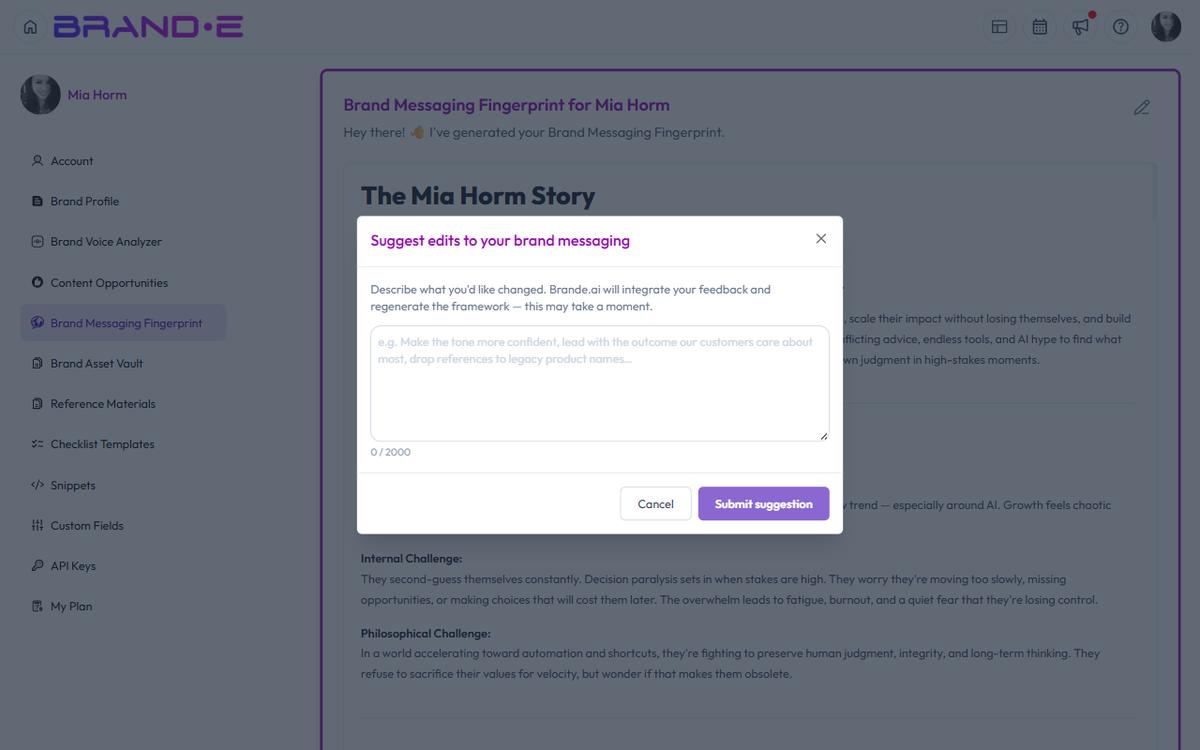
It captures your narrative arc, core messages, and value propositions that set you apart.
As your brand grows, your messaging should evolve to reflect new positioning, products, and market realities.
Outdated messaging creates missed opportunities and weaker content.
What the Brand Messaging Fingerprint Is
Your messaging framework answers:
- What is your origin story? Why did you start this?
- What problem do you solve? What is the core pain point?
- Why is your solution different? What's your unique approach?
- What are your value propositions? What specific benefits matter most?
- What story do you want to tell? What narrative arc do you want customers to experience?
- What are your key messages? What 3–5 messages should every piece of content reinforce?
This framework is created during onboarding or updated manually in your Brand Messaging Fingerprint page.
Brande.ai references this when generating content.
Where to Update Your Messaging Framework
Navigate to Account → Brand Messaging Fingerprint.
You'll see your current framework and options to edit each section.
When to Update Your Messaging Framework
When you enter a new market segment
If you've expanded to serve a new customer type:
- Update messaging to speak to the new segment's pain points
- Highlight value propositions that matter to new segment
- Adjust story to show proof in new market
Example update:
Old messaging:
"We help marketing agencies scale content production for tech clients."
New messaging:
"We help marketing agencies scale content production. Originally built for tech, now serving professional services, financial services, and consumer brands equally."
When your product significantly changes
If you've launched major new features or pivoted:
- Update value propositions to reflect new capabilities
- Adjust competitive positioning
- Highlight new use cases or benefits
Example update:
Old messaging:
"Content generation tool for social media teams"
New messaging:
"Brand-aware content operating system that turns your brand strategy into written and visual content at scale"
When competitive landscape shifts
If competitors change or new entrants arrive:
- Update your differentiation angle
- Emphasize what still makes you unique
- Remove claims that are no longer defensible
Example update:
Old messaging:
"The fastest content generator on the market"
New messaging:
"The only platform that uses your Brand DNA to generate consistent content. We're not faster, we're smarter about what you should create."
When your pricing or positioning changes
If you've repositioned, changed tiers, or launched new offerings:
- Update messaging to reflect new positioning
- Highlight what now matters most to customers
- Adjust value messaging to new customer profile
Example update:
Old messaging:
"Affordable content tool for small businesses"
New messaging:
"Scalable content system for agencies and teams managing multiple brands"
Quarterly strategy refresh
Every 90 days, review:
- Is this messaging accurate?
- Does it reflect current brand positioning?
- Have we learned new customer insights that should shift messaging?
- Is competitive positioning still valid?
Update if needed.
When you hit new milestones
When something significant happens:
- Closed major customer or partner
- Raised funding
- Hit revenue milestone
- Won industry award
Consider whether it affects your messaging framework.
Often, it does.
Example update:
Old messaging:
"Growing startup focused on content generation"
New messaging:
"Series A-funded content operating system trusted by 500+ agencies and in-house teams"
How to Update Your Messaging Framework
1. Navigate to Brand Messaging Fingerprint
Go to Account → Brand Messaging Fingerprint.
2. Review Current Framework
Read through your current messaging across all sections.
Does it sound right?
Does it reflect your current positioning?
Mark sections for update.
3. Update Each Section
Click to edit each part:
- Origin Story: Why did you start? What motivated you?
- Problem/Opportunity: What specific pain point are you addressing?
- Your Solution: What's your approach? How do you solve it differently?
- Value Propositions: What specific benefits do you deliver? List 3–5.
- Proof/Evidence: What proof do you have that this works?
- Call to Action: What do you want people to do?
4. Keep It Specific
Replace vague messaging with specific, measurable statements.
Weak messaging:
"We help teams work better"
Strong messaging:
"We reduce content creation time from 8 hours to 2 hours per project while improving consistency across all channels"
5. Test Against Current Content
After updating, review your recent best-performing content.
Does it align with the new messaging framework?
If not, something might be off.
Either the framework needs adjustment or your content is drifting off-message.
6. Brief Your Team
If you have teammates or collaborators, share the updated framework.
Everyone should align on the new messaging.
Content generation works best when the whole team speaks the same narrative.
Example Messaging Framework Updates
Update: Product Expansion
Before:
Origin Story: "We built this to help social media teams create faster"
Problem: "Social media content planning is time-consuming"
Solution: "AI-powered templates and generation"
Value Props: "Speed, ease of use, consistency"
After:
Origin Story: "We built this because content quality was suffering at scale. Agencies and in-house teams were choosing speed over quality. We decided there was a third way."
Problem: "Content teams face a choice: scale fast (sacrificing quality) or maintain quality (sacrificing speed). There's no third way."
Solution: "Brand DNA system that makes your brand knowledge reusable. Content generation then becomes execution, not ideation."
Value Props: "Speed + consistency, reduced approval cycles, on-brand output every time, scalable to multiple brands"
Update: Market Expansion
Before:
Solution: "Built for tech startups and SaaS teams"
Proof: "Used by 100+ tech teams"
After:
Solution: "Built for agencies and in-house teams across industries"
Proof: "Used by 500+ teams across tech, professional services, financial services, and consumer brands"
Update: Competitive Positioning
Before:
"We're the fastest content generator"
After:
"We're the only platform that starts with strategy (Brand DNA) not templates. Smarter content = better engagement = higher ROI"
Update: Pricing Tier Introduction
Before:
"One plan, one price"
Value Props: "All features for one price"
After:
"Three plans: Starter (solo founders), Growth (agencies and teams), Enterprise (multi-brand at scale)"
Value Props: "Plans that grow with your needs, no overpaying for features you don't use"
Best Practices for Messaging Updates
Keep your core story intact
You can update details, but don't reinvent your origin story every quarter.
Consistency matters.
If you've genuinely evolved (new market, new product), update the story.
If you're just tweaking, keep core narrative.
Make updates specific and measurable
Replace generic messaging with data-backed claims.
Before: "Help teams save time"
After: "Reduce content creation time by 60% and approval cycles from 5 days to 24 hours"
Align messaging across all channels
After updating, make sure messaging appears in:
- Website copy
- Sales materials
- Social media bios
- LinkedIn headline
- Email templates
- Content Agent briefs
Consistency across channels reinforces messaging.
Test messaging before rolling out
Share updated framework with a few trusted advisors or customers.
Does it resonate?
Does it sound authentic?
Adjust based on feedback.
Don't chase every trend
Updates are good, but constant rewrites weaken your brand.
Update when something fundamental changes.
Otherwise, stay consistent.
Version your frameworks
Keep old frameworks for reference.
Seeing how your messaging evolved over time is valuable context.
Some platforms let you view history.
Use it.
How Updated Messaging Affects Content
When you update your messaging framework, Brande.ai immediately references the new framework in content generation.
Example:
Old framework emphasizes: "We're fast"
Content generated: "Create content in minutes, not hours"
New framework emphasizes: "We're smart about strategy"
Content generated: "Instead of wondering what to write, your Brand DNA tells you what matters. Create the right content at the right time."
Updated messaging = stronger, more aligned content.