

Appearance
Content Agent vs Manual Content Creation
Content Agent and manual content creation serve different purposes in your workflow. Understand when to use each to maximize your content output and brand consistency.
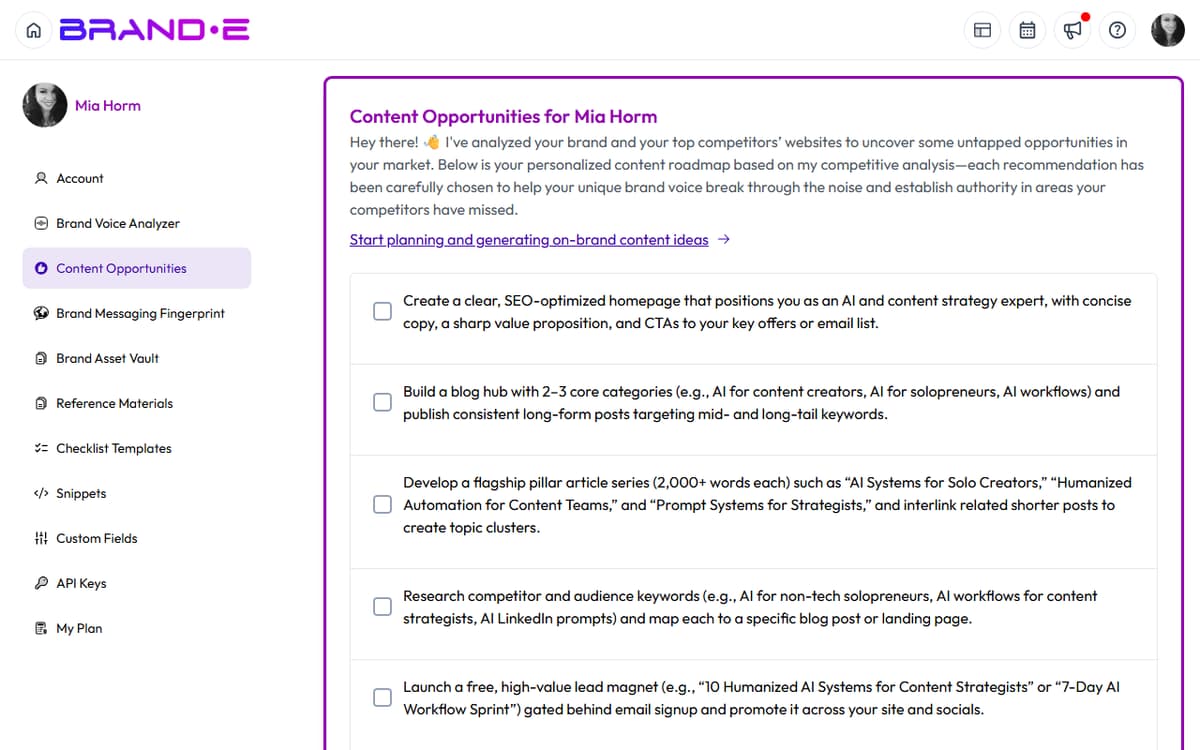
Quick Comparison
| Aspect | Content Agent | Manual Content Creation |
|---|---|---|
| Planning | Automated strategy | Your decision |
| Input | Brand DNA analyzed daily | Your chosen template + prompt |
| Frequency | One brief per channel per day | Create on-demand |
| Best for | Planned strategy & daily briefs | One-off requests, urgent topics |
| Time to first draft | 2-3 minutes (including customization) | 5-10 minutes (prompt writing) |
| Brand alignment | Always aligned to Brand DNA | Only as good as your prompt |
Content Agent: Strategy-First Workflow
Content Agent generates daily briefs that pre-decide what you should create. Use it when:
When to use Content Agent:
- Your content calendar is empty — Instead of staring at a blank calendar, pull from today's briefs
- You want strategy automated — Stop deciding what to write; let Content Agent decide based on audience needs
- You manage multiple channels — Get one recommendation per channel so your audience hears from you everywhere
- You want brand consistency — All recommendations come from the same Brand DNA, ensuring nothing feels off-brand
- You manage multiple brands — Each brand gets its own daily briefs; switch between brands without confusion
- You have limited planning bandwidth — Content Agent does the hard work of deciding; you execute
Content Agent's advantage: Removes the blank-page problem. Your brain does not have to decide what to write; you only decide if Content Agent's recommendation is right for today.
Manual Content Creation: On-Demand Workflow
Manual content creation starts with a blank template and your prompt. Use it when:
When to use manual creation:
- You have an urgent, specific request — A breaking news story, a customer issue, or a time-sensitive announcement that Content Agent has not recommended
- You want creative control from scratch — Build something entirely custom without fitting a recommended framework
- You are testing a new topic or angle — Experiment with messaging that is not yet part of your Brand DNA
- You need to repurpose existing content — Take an old blog post and turn it into a LinkedIn series
- You want to write yourself — Some creators prefer the manual workflow; use it if it feels natural to you
Manual creation's advantage: Flexibility. You can create anything anytime without waiting for daily briefs.
How Most Teams Use Both
Successful teams use Content Agent for 70-80% of their content and manual creation for 20-30%. Here is a typical week:
Monday: Content Agent recommends a blog post about industry trends. You customize and generate. (Content Agent)
Wednesday: A major competitor announcement breaks. You need a response post fast. You manually create a Twitter thread on the fly. (Manual)
Friday: Content Agent recommends a case study email. You generate it, then manually create a follow-up email for non-respondents. (Both)
Monday (next week): Content Agent recommends LinkedIn and blog content. You generate both and organize them into a campaign folder. (Content Agent)
This balance keeps you strategic (using Content Agent for 80% of decisions) while keeping you flexible (using manual creation for the 20% that is truly unexpected).
Cost and Efficiency
Content Agent efficiency:
- Generates 30-40 briefs per month (depending on channels and plan)
- Each brief takes 2-3 minutes to customize and generate
- Roughly 1-2 hours of content planning and generation per month
- Removes the time of "What should I write today?"
Manual creation efficiency:
- Dependent on your prompt quality and creativity
- Average 5-10 minutes to write a good prompt
- Average 2-5 minutes for AI to generate the first draft
- Total time per piece: 10-15 minutes
Trade-off: Content Agent saves planning time by deciding for you. Manual creation gives you more control but requires you to decide and prompt.
When to Switch From One to the Other
Switch to Content Agent If:
- You are manually creating the same types of content repeatedly
- Your content feels generic or off-brand
- You spend more than 30 minutes per week deciding what to write
- You are managing multiple brands or channels
- Your audience feedback is "where do I find your content?"
Switch to Manual Creation If:
- You have an idea that does not fit any Content Agent brief
- Your industry moves so fast that daily briefs feel outdated
- You prefer full creative control and quick iteration
- Your audience wants unique, experimental content regularly
Example Workflows
Workflow 1: Agency (Using Mostly Content Agent)
A 3-person agency manages 5 client brands.
Monday morning: Log in, review Content Agent recommendations for all 5 brands. Generate 8 briefs total (average 1-2 per brand per day).
Monday afternoon: Move generated projects into client folders. Send one to a client for review.
Wednesday: Client approves the content. One project is published. Still using recommendations from Monday.
Friday: One of the clients has an urgent announcement. Use manual creation for a quick social media post.
Result: 90% of work is Content Agent (strategic and repeatable). 10% is manual (urgent and custom).
Workflow 2: In-House SaaS Team (Using Both Equally)
A 2-person content team at a SaaS company.
Daily: Check Content Agent recommendations. Generate 2-3 that fit this week's priorities.
As needed: Create manual content for product launches, urgent bug fixes, or customer success stories that are not yet in Brand DNA.
Monthly: Update Brand Profile with new topics, use cases, or positioning that worked well.
Result: Content Agent provides a reliable baseline of strategic content. Manual creation handles the agility needed in fast-moving SaaS.
Workflow 3: Solo Founder (Using Content Agent Mostly)
A solo founder with limited time.
Monday morning: Open Content Agent, see 4 recommendations (LinkedIn, Blog, Email, Podcast).
Monday: Generate 2 of them (LinkedIn and Blog). Customize quickly based on recent customer wins.
Tuesday-Thursday: Publish the 2 pieces. Refine them based on feedback.
Friday: Manually create one quick Twitter thread based on customer questions.
Result: Content Agent handles the planning so the founder only executes. Manual creation fills in gaps.
Measuring What Works
Track which content performs better: Content Agent briefs or manual creations.
- Do Content Agent briefs get more engagement because they are strategy-aligned?
- Do manual creations get more engagement because they are timely or unique?
- Does audience size or type matter?
Use these insights to adjust your mix. If Content Agent briefs consistently outperform, lean harder into them. If manual content resonates more, add more topics to your Brand Profile so Content Agent recommends them.